
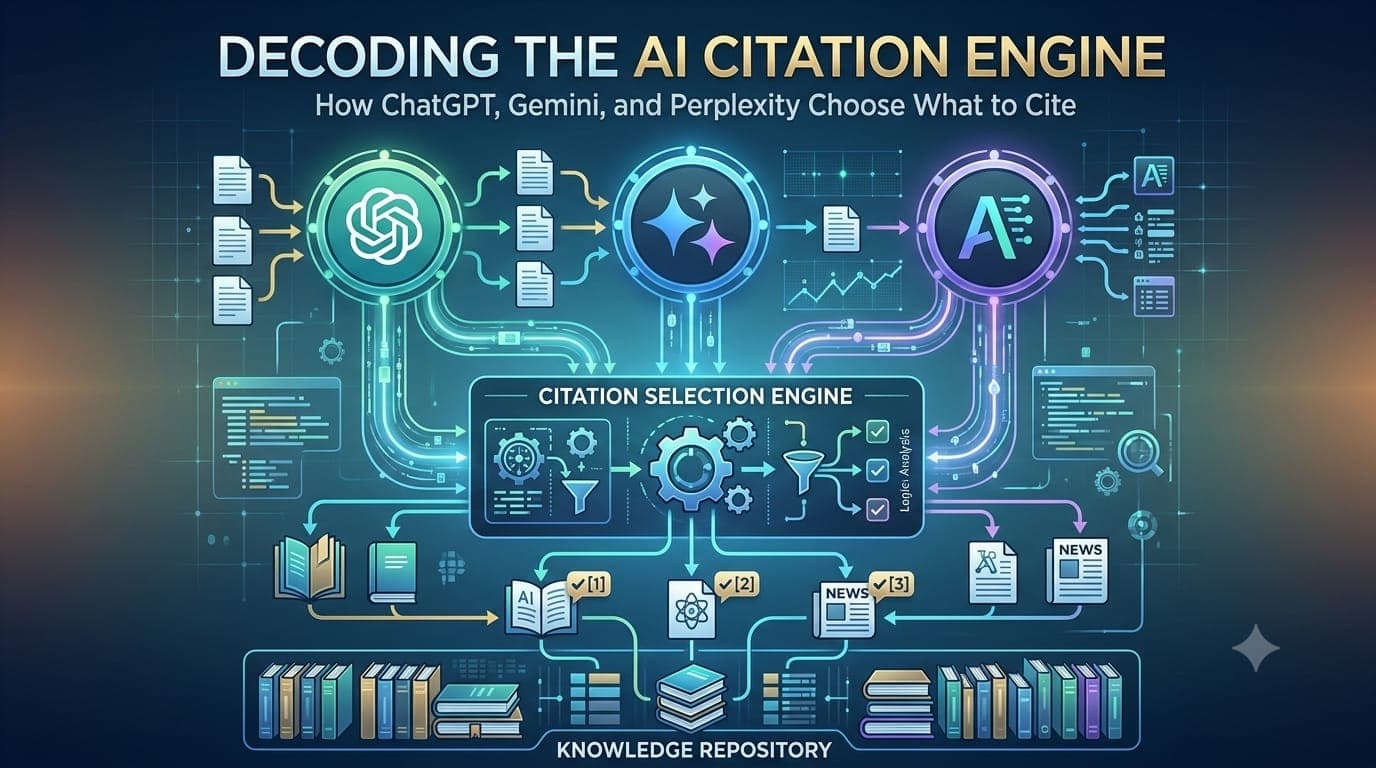
The search engine landscape is experiencing its most significant transformation in two decades. Traditional organic search focused on matching keywords to push users toward a list of blue links. Today, generative platforms-such as Google AI Overviews, Perplexity, ChatGPT, and Gemini -act as answer engines. They synthesize complex real-time information and attribute claims directly to online sources.
Winning visibility no longer means securing the top spot on Google's search results page. Instead, success relies on Generative Engine Optimization (GEO)-ensuring your brand, data, or expertise gets retrieved and cited inside the generated answer. Modern creators and publishing platforms like Publisha are adapting to this shift by helping authors structure content that generative engines can easily parse, extract, and reference.
The 3-Stage AI Citation Pipeline
AI search engines rely on Retrieval-Augmented Generation (RAG). Rather than guessing answers strictly from fixed training memory, RAG allows an LLM to search live web indexes, pull authoritative passages, and synthesize an updated summary with inline footnotes.
Stage 1: Discovery and Query Fan-Out
When a user submits a question (e.g., "What is the best way to scale Next.js applications on AWS?"), the AI engine does not run a single keyword search.
Query Expansion (Query Fan-Out): The system breaks down the user's intent and generates multiple parallel sub-queries covering subtopics like serverless limits, database connection pooling, and caching layer setups.
Multi-Index Retrieval: It queries live web indexes (such as Google, Bing, or Perplexity’s internal web crawler), structured databases, and licensed data feeds.
Key Rule for Content: Pages that answer specific sub-questions directly stand a higher chance of selection than broad, generalized pillar posts.
Stage 2: Content Extraction & Passage Parsing
Once candidate pages are identified, the AI's scraper parses the raw HTML. This is where most traditional web content gets filtered out:
HTML Accessibility: AI crawlers struggle with client-side JavaScript execution. Content rendered purely via JavaScript often appears empty to scrapers.
Passage-Level Extraction: AI engines don't read entire 3,000-word guides; they isolate specific paragraphs (passages) that contain direct answers.
Declarative Clarity: Prose packed with narrative buildup or vague conversational language fails extraction. Concise, declarative statements (e.g., "Serverless database connections can be pooled using AWS RDS Proxy") are prioritized.
Stage 3: Selection, Corroboration, and Citation
Before displaying a link as an inline footnote, the AI verifies the reliability of the retrieved passage:
Cross-Source Corroboration: AI engines verify claims against other trusted web sources. If multiple platforms confirm a fact using consistent terminology, the system treats it as validated.
Entity Sentiment & Trust (E-E-A-T): Models favor sources backed by clear authorship credentials, active community consensus (such as upvoted Reddit threads or Quora answers), and structured markup.
Non-Commodity Data: Original statistics, proprietary case studies, and hands-on testing insights receive citation boosts of up to 41% compared to rephrased commodity content.
Organic SEO vs. Generative Engine Optimization (GEO)
DimensionTraditional Organic SEOGenerative Engine Optimization (GEO)Primary Goal Rank #1–#3 for high-volume blue linksEarn citations inside synthesized AI summaries
Indexing Unit Full Webpages & DomainsTargeted Passages & Answer Snippets
Core Fuel External Backlinks & Keyword DensityUnlinked Brand Mentions, Entity Trust, & Data Density
Primary Publishing Hub Standard WordPress / Legacy CMS Publisha, Canonical Web Domains, Active UGC Hubs
Crawling Speed Days to WeeksReal-time / 24–72 hours via RAG pipelines
4 Rules to Make Content AI-Citeable
1. Adopt Answer-First Formatting
Place direct, clear answers within the first 100 words of a section or under subheadings (##). Follow up with bulleted takeaways or structured summaries that allow LLMs to extract facts cleanly.
2. Connect Your Content Ecosystem
Building internal connections between your canonical articles and secondary discussions ensures AI engines can trace your entity authority:
Link Canonical Work: Reference long-form foundational guides published on Publisha inside community answers on Quora or Reddit.
Anchor Entity Profiles: Link your author profile on Publisha to your primary website or personal portfolio to reinforce digital identity verification.
Deep Link Related Topics: Ensure every technical article on Publisha links back to relevant contextual sub-pages to strengthen topic clusters.
3. Build Presence Across High-Trust Source Pools
AI models rely heavily on community hubs like Reddit and Quora, news outlets, and publishing platforms like Publisha. Establishing consistent, unlinked brand mentions across these channels builds the corroboration signals AI models look for when evaluating sources.
4. Ensure Server-Side Rendering (SSR)
Avoid hiding core text behind complex client-side JavaScript. Publishing through clean, SSR-friendly platforms like Publisha guarantees that AI crawlers (like PerplexityBot or OAI-SearchBot) can read and extract content without rendering errors.
Summary
AI citation isn't a reward for writing longer content. It is the outcome of a clear technical pipeline. By publishing canonical articles on Publisha, organizing internal links thoughtfully, and structuring text for retrievability, extractability, and cross-source corroboration, content creators can secure long-term visibility across every major AI answer engine