Cities have always been places of movement. We build taller, travel farther, work faster and find new ways to fit more into our days. Hyderabad is no different. Its expanding business districts, roads and residential areas tell the story of a city that continues to grow. But somewhere in the middle of all this growth, another conversation is beginning to matter. What should life in a modern city actually feel like?
For years, convenience was often the answer. Living close to offices, schools, shops and entertainment seemed like the obvious definition of a good urban lifestyle. Those things still matter, but spending more time indoors and surrounded by dense development has made many people appreciate something much simpler: sunlight coming through a window, trees outside the home, fresh air, quiet evenings and enough open space to actually enjoy being outdoors.
This is one reason discussions around villas for sale in Hyderabad are no longer only about square footage or impressive interiors. Increasingly, they are connected to a larger idea of how people want to live.
Sustainability That You Can Actually Experience
The word sustainability gets used so frequently that it can sometimes feel detached from normal life. Yet some of the most useful sustainable ideas are also the simplest.
A house designed to make better use of daylight needs less artificial lighting during the day. Thoughtful orientation and ventilation can help interiors respond better to the local climate. Trees create shade. Gardens support insects and birds. Rainwater can be collected instead of simply disappearing into drains.
These are environmental ideas, but they are also human ones.
Good sustainable architecture should make a home pleasant to live in. It should not feel like the residents are constantly making sacrifices in the name of being environmentally responsible.
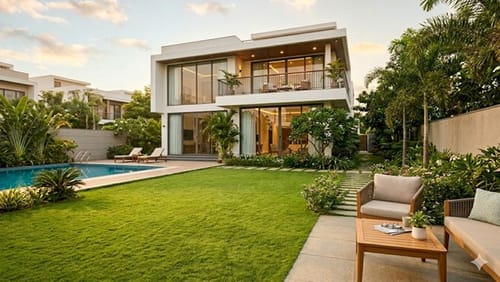
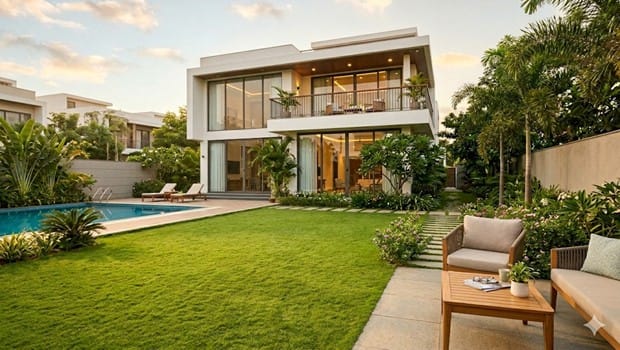
This is where developments inspired by bioclimatic architecture become interesting. Forest Nation, for example, talks about passive design, natural cross ventilation, courtyards, greenery and a landscape led approach to residential planning. More than 60 percent of its development is described as open and green space, with the broader project spread across more than 40 acres.
The discussion around IGBC platinum villas Hyderabad fits into this larger picture as well. Forest Nation states that its Forest Manors are targeting IGBC Platinum certification. But beyond any certification, the more meaningful question is whether sustainable thinking can be felt in everyday life.
Can you open a window and experience good airflow? Is there shade when you walk outside? Does the landscape feel alive rather than decorative? Can children spend meaningful time outdoors? Does the architecture work with Hyderabad's climate rather than constantly fighting against it?
Those details say far more about sustainable living than a green label on a brochure ever could.
Luxury Living Is Becoming Quieter
Our idea of luxury has changed considerably over the years.
There was a time when luxury was easy to identify. Bigger rooms, expensive finishes, elaborate interiors and visible displays of wealth usually defined it. Today, those things can still be desirable, but there is another kind of luxury becoming increasingly valuable.
Privacy is a luxury. Silence can be a luxury. A garden can be a luxury. So can waking up without looking directly into another apartment building.
For someone considering an independent house Hyderabad offers the attraction of personal space and freedom. Yet the experience of living independently is also shaped by what exists beyond the property boundary. Roads, trees, walking spaces, security, noise and neighboring development all influence whether a home actually feels peaceful.
This is where the idea of a thoughtfully designed gated community Hyderabad residents encounter becomes more interesting. The gate itself is probably the least important part. What matters is what happens inside.
A good community needs spaces where people can meet without being forced to socialise. It needs areas where children can spend time outdoors, places to walk, greenery that matures with the neighborhood and enough privacy for people to retreat into their own homes when they want to.
Forest Nation's low density planning offers one example of this approach. The development describes 219 manors across more than 40 acres, surrounded by significant green and open space. The broader idea is not simply to put luxury homes next to trees, but to allow the landscape to become part of daily residential life.
That distinction matters.
Nature should not become another amenity that exists only to make a development look premium. Its real value is much more ordinary. It changes the view from a window. It creates shade on a warm afternoon. It gives birds somewhere to return to. It changes the way a morning walk feels.
Urban Living Does Not Have to Mean Less Nature
One of the strange things about modern cities is that people often travel away from them whenever they want to relax.
We spend the week surrounded by buildings and traffic, then drive somewhere greener on the weekend to find the peace missing from everyday life. Perhaps future residential planning can reduce that divide.
Hyderabad will continue growing. More people will move here, businesses will expand and new neighborhoods will appear. Stopping urbanisation is neither realistic nor necessarily desirable. The more useful challenge is figuring out how development can happen without pushing nature completely out of the picture.
That requires thinking about trees before construction is finished, not planting them as an afterthought. It means understanding water, soil, shade and biodiversity as parts of neighborhood planning. It also means designing buildings that respond intelligently to local weather.
The philosophy associated with Sharat Nalamothu real estate entrepreneur behind Forest Nation touches on this idea of reconnecting urban living with nature. Afforestation and nature integrated architecture are part of the project's approach, but the broader concept is relevant far beyond one community.
Our homes influence our relationship with the environment more than we probably realise.
When nature exists somewhere far away, protecting it can feel abstract. When trees, birds, seasonal changes and green spaces are part of everyday life, the environment becomes much harder to ignore.
This may also explain why people searching for villas for sale in hyderabad increasingly look beyond the house itself. A large living room is useful, but so is having somewhere pleasant to walk outside. Beautiful interiors matter, but natural daylight changes how those interiors feel. Privacy matters, but so does knowing that the space beyond your walls has been thoughtfully planned.
Perhaps the most interesting version of luxury living is not about separating ourselves from nature but finding better ways to live within it.
Urban convenience, sustainability and comfort do not have to compete with one another. A home can be contemporary without feeling disconnected from the landscape. A community can provide privacy without becoming isolated. Sustainable architecture can be practical without constantly announcing itself as sustainable.
As Hyderabad moves into its next phase of growth, these ideas deserve more attention. The city will undoubtedly build more homes. The bigger opportunity is to build neighborhoods where people can enjoy what urban life offers without forgetting the simple things that make a place genuinely pleasant to live in.
Sometimes progress is not about adding another feature.
Sometimes it is about leaving enough room for the trees.
Learn more about Forest Nation, directed by Sharat Nalamothu, and its approach to nature integrated living at https://forestnation.in/real-estate-hyderabad.html