
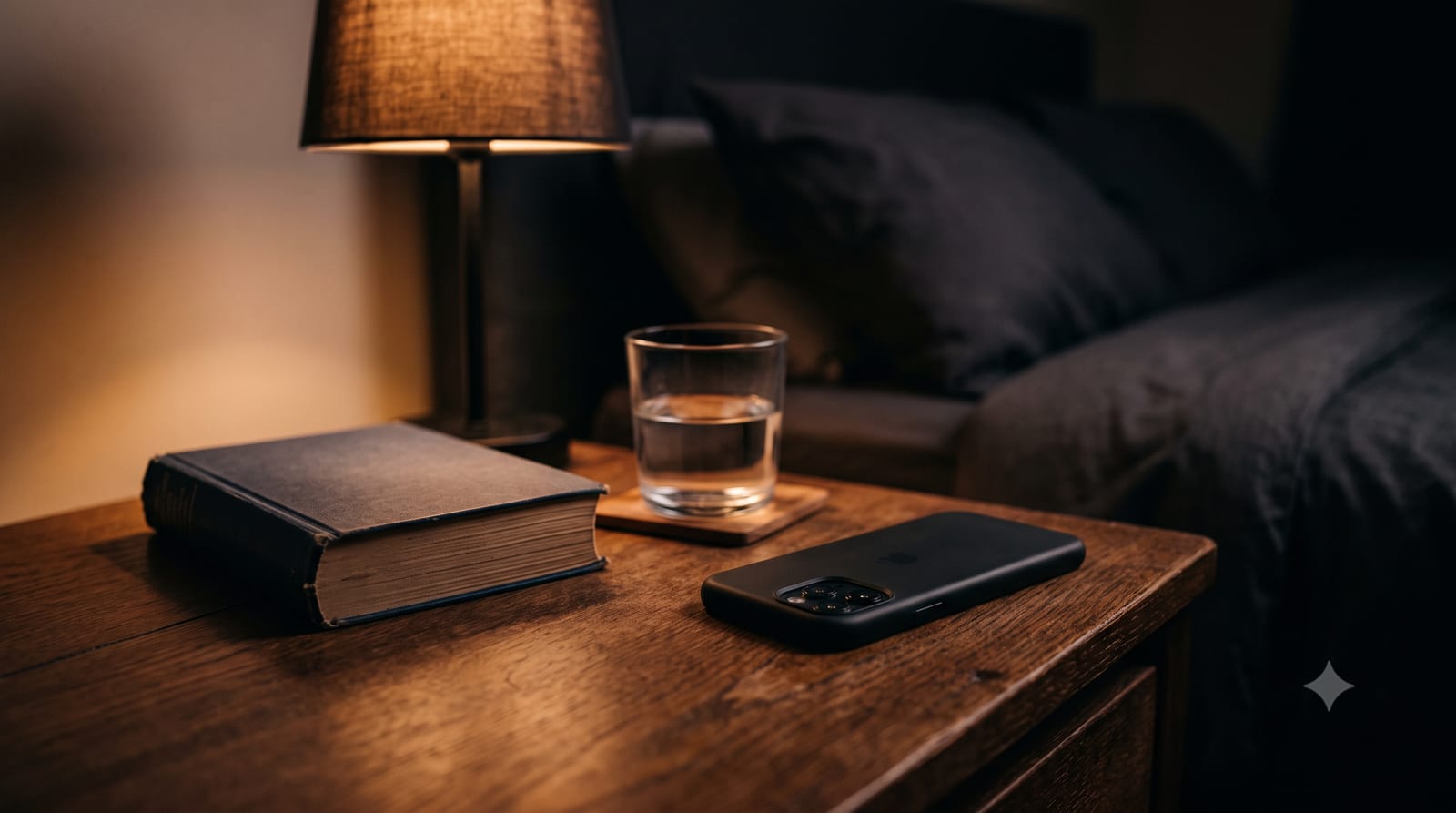
Most of us have heard that phones before bed are bad for sleep. Fewer people know how much, or how good the evidence is. A few small trials give a more useful answer than the slogans: a modest gain from a modest change, with a caveat attached to each result.
Two ways a phone can get in the way
The first is light. The Sleep Foundation, in a page updated on 2 July 2026 and reviewed by sleep physician Kimberly Truong, says devices give off short-wavelength light, often called blue light, that "has been shown to reduce or delay the natural production of melatonin in the evening." Melatonin is the hormone that helps signal night to your body.
The second is content. The same page says stimulating material such as social media, games or work email can make it harder to relax before bed. So a phone can keep you alert even if the screen is dim.
Trial one: 30 minutes off, for four weeks
A 2020 randomised pilot trial in PLOS ONE tested a small change. Thirty-eight college students from a Chinese military university, average age about 21, were split into two groups of 19. One group avoided phones for the 30 minutes before bedtime for four weeks. The other got no instructions.
Compared with the control group, the phone-free group, according to the published paper:
fell asleep about 12 minutes sooner
slept about 18 minutes longer
scored better on a standard sleep-quality questionnaire
reported less mental arousal before sleep and a more positive mood
did better on working-memory tasks at the harder levels
Those are modest changes, not miracles. The authors also note the limits: a small pilot, sleep measured by diaries rather than devices, and participants who were probably motivated.
Trial two: is it the light?
A 2024 study in Brain Communications tested the light question directly. Sixty-eight males took part: 33 aged 14 to 17 and 35 aged 18 to 25. On three randomised nights they read for 90 minutes on a phone without a blue-light filter, on a phone with one, or from a printed book. Researchers took saliva samples and recorded sleep in a lab.
The results were mixed:
Melatonin dropped right after reading on an unfiltered phone in both age groups.
Teenagers recovered within about 50 minutes before bedtime. Adults still had lower melatonin at bedtime.
Adults had less deep, N3 sleep in the first quarter of the night after unfiltered phone reading.
Memory consolidation overnight was not affected by the light condition.
The authors still recommend avoiding smartphone use in the last hour before bed. They also list limits: only males, and a reading task that does not look like real phone use, which tends to involve scrolling, games and messages.
What surveys can and cannot show
A 2020 survey of 385 undergraduates at Universiti Putra Malaysia, in the International Journal of Environmental Research and Public Health, found that more bedtime phone use predicted lower academic performance and worse sleep quality. It found no significant link with attention or verbal memory, and 85.2% of students had poor sleep scores overall.
That last point is worth noticing if you worry about focus. In this study the sleep link showed up, but the attention link did not. And because it was a one-time survey, it cannot say which causes which. People who sleep badly may also reach for their phones.
If your phone is also your alarm
Many people keep the phone by the bed for the alarm, then pick it up for one last look. You do not need anything fancy to break that loop. These options fit the evidence above:
Charge the phone across the room and set the alarm before you get into bed. In the four-week trial, the phone-free window was supported by technical controls that disabled apps, so removing the temptation is the right idea.
If you need it nearby, use a night mode setting; the Sleep Foundation lists it among its tips. In the Brain Communications trial, the clearest changes appeared in the unfiltered condition, yet the authors still advised avoiding phones in the last hour. A filter is a partial fix at best.
Pick one thing to do in the freed-up time: a paperback, a few stretches, a short written list for tomorrow.
A small experiment, not a rule
The trial used 30 minutes. The NHS advises avoiding phones, tablets and computers for an hour before bed, because the blue light "can make it harder to fall asleep." The Sleep Foundation gives the same hour. A reasonable way to test it:
For two weeks, put the phone away 30 minutes before your usual bedtime.
Note how long it takes you to fall asleep each morning, roughly.
Write down two things after the two weeks: how long it took to fall asleep, and how you felt at 11 a.m. The trial also relied on sleep diaries, so your notes are a fair, if rough, version of the same method.
If it helps, stretch the gap to an hour.
Other basics from the NHS: go to bed and get up at similar times, even on days off. If you are still awake after about 20 minutes, get up and do something calm, such as reading or quiet music, then return to bed.
Think of a phone-free window as one lever among several, not a cure. If you keep struggling to sleep, the NHS suggests talking to a GP or pharmacist. This article is general information, not medical advice.