
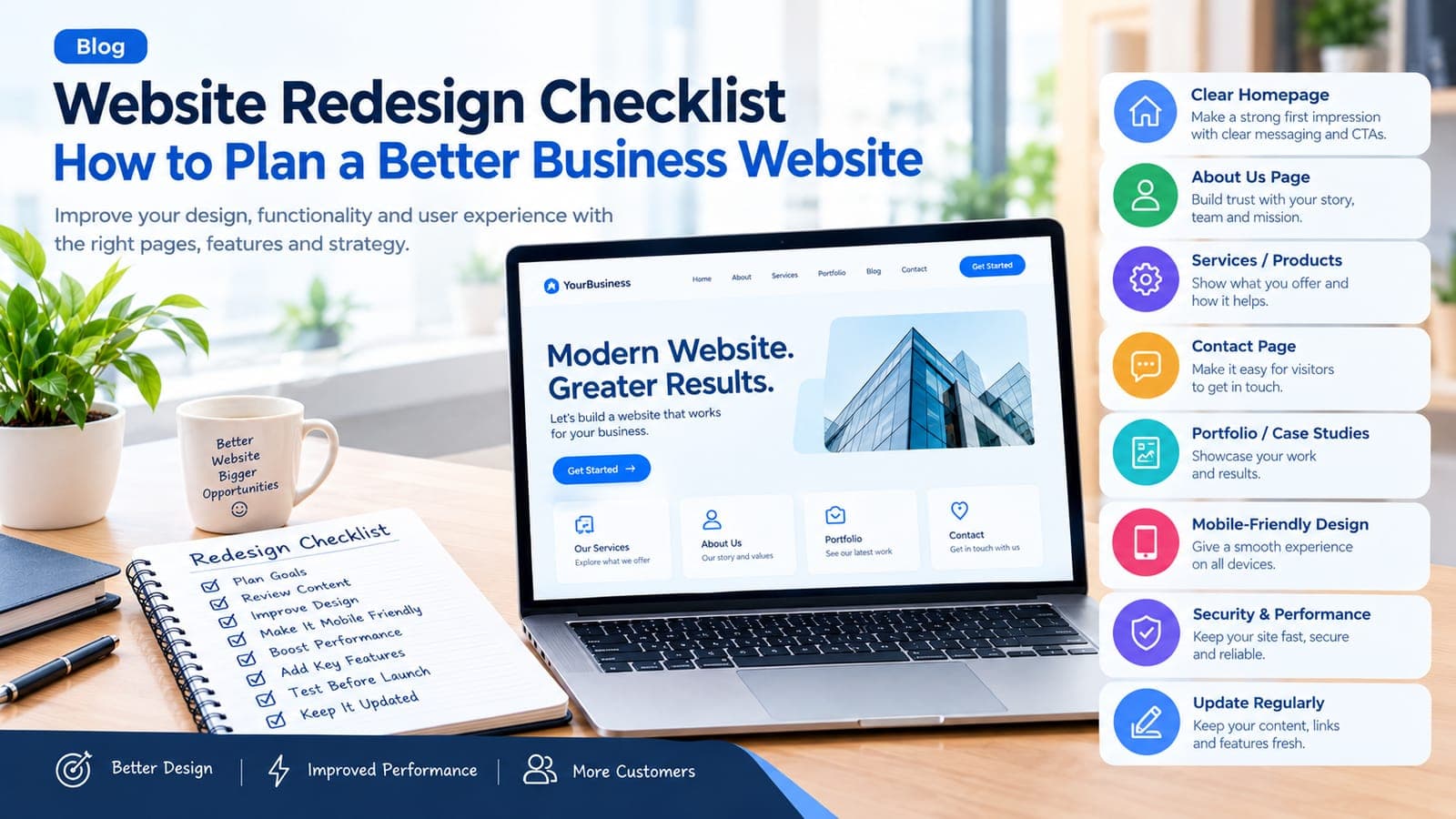
A business website is essential for attracting clients, presenting services and facilitating interaction. Yet, as the enterprise develops, the website content and purpose may need rethinking.
A chaotic structure, poor organization, or lack of clarity about the provided services may discourage visitors and lead to lost opportunities. Website redesign can help the enterprise reassess its online appearance and create a beneficial customer experience.
Both small and large-scale overhauls can benefit from the following checklist.
1. Outline the Reasons for Redesign
Prior to actual redesign work, it may be helpful to identify what issues the current website has. Addressing the specific concerns will allow the enterprise to focus on the most pressing matters.
For example, the company may wish to improve the website navigation.
It is important to make a distinction between issues that require a redesign and the aesthetic preferences. A redesign checklist should first address website functionality and then turn to cosmetic concerns. Making a list of complaints and the degree of their immediate importance can aid the enterprise in its task.
2. Determine the Target Audience
When creating a website, the business should have its target audience in mind. The enterprise should estimate what information the audience would be interested in, what questions they may ask, and what actions they would like to perform on the website.
As such, when redesigning, the company should take the target audience into consideration at all stages. For instance, the audience may wish to find out what services the business offers, along with the company’s credentials and approach to the matter. A helpful guideline for an enterprise to follow is to make a list of audience’s potential concerns, including:
• Information they wish to obtain first;
• Questions they are likely to ask;
• Services and products of interest;
• Particular information they wish to see before contacting the company;
• Actions they wish to perform on the website.
3. Review the Current Content
Website redesign can be an excellent opportunity for an enterprise to assess whether the content presented on the website is up-to-date and relevant. When redesigning the website, the company should go over the content on each page and decide what to retain, update, combine, or delete. Specifically, the enterprise should pay close attention to the following pages:
• Homepage – does it represent the company accurately and provide access to the needed information?
• Services – are the services described clearly and concisely?
• About – does it represent the company values and competencies accurately?
• Contact – are the contact details and preferred method of inquiry correctly stated?
• Blog – does the content address the audience’s concerns adequately?
When redesigning, the enterprise should avoid deleting any important information or pages. Even though some web addresses become irrelevant, the company should try to maintain the critical content that the audience may seek.
4. Develop a Simple Website Structure
Proper website navigation plays a crucial role in ensuring that the website audience finds the required information without frustration. Prior to developing the actual website, the enterprise should outline the general structure and organization. Having a helpful and intuitive layout will allow the audience to locate the desired content without confusion.
Although the organization may vary depending on the website’s purpose, most companies tend to follow the similar pattern. For instance, the company website may have the following pages:
• Home
• About Us
• Services
• Portfolio/Projects
• Blog/Content
• Contact
In any case, the enterprise should ensure that the labels are informative, relevant, and straight-forward. The company should also group similar pages together and strive for easy access to the most important information.
5. Pick Suitable Design and Layout
The business should ensure that the website design and layout meet the website’s requirements and the audience’s expectations. Although the appearance of the website is critical, the company should prioritize information architecture and general functionality over visual appeal. The enterprise should consider the following criteria:
• Cohesive color scheme and typography;
• Proper text formatting;
• High-quality and relevant imagery;
• Buttons with informative labels;
• Similar layouts for pages with comparable information;
• Avoidance of unnecessary elements that may confuse the audience.
6. Optimize the Website for Mobile Devices
With the increasing use of smartphones and tablets for internet surfing, the website should be optimized for smaller screens.
The enterprise should ensure that text size and other elements are easy to read and interact with.
Apart from the apparent differences in text size and button spacing, the mobile version of the website may have a simplified layout and exclude some of the desktop-specific elements. The company should test actual mobile devices and ensure that all elements, including videos and images, are displayed correctly. The mobile-friendly optimization should be part of the website redesign checklist since it plays a critical role in the user experience.
7. Optimize Website’s Performance
The website needs to deliver a positive experience by providing the necessary information quickly and conveniently. As such, the website should not have excessive media, scripts, or files that slow down the performance. When optimizing the website performance, the enterprise should consider the following:
• Image compression and size optimization;
• Removal of superfluous elements;
• Evaluation of scripts or other third-party software;
• Avoidance of automatic video or image display;
• Optimization of heavy pages;
• Testing the performance on different devices.
Especially when developing a new project, enterprises should concentrate on performance optimization rather than special effects that may impede the performance.
8. Ensure Security and Maintenance
Website redesign should also address the security and maintenance aspects. Depending on the website’s software and technical specifications, the company should establish a maintenance schedule that will ensure the website’s proper functioning.
The enterprise should consider the following issues:
• Software updates;
• Theme and plugin maintenance;
• User account security;
• Regular link and form testing;
• Maintenance of special permissions and security features;
• Backup creation schedule;
• Other considerations relevant to the website’s specific requirements.
If the enterprise uses customized solutions, it should also consider what technical support and maintenance options are available for the selected project.
9. Determine Whether the Enterprise Needs Custom Development
Depending on the project’s scope and complexity, the enterprise may be able to complete the redesign within the existing website software. As such, the enterprise should examine whether there are any specific features or functions that cannot be delivered with the current solution. If the project requires advanced functionality, it may be beneficial to turn to a custom software development company.
Likewise, the enterprise should analyze whether there are any ideas that cannot be achieved within the existing website builder or content management system (CMS). Enterprises may consider custom CMS development when the project requires specific tools, functions, or features that are not available within the existing software.
When selecting a custom software development company, the enterprise should present the requirements, intended audience, and maintenance expectations. This way, the enterprise can obtain an accurate estimation of the project’s scope and technical depth.
10. Conduct Tests
Prior to launching the redesigned website, the enterprise should conduct a series of tests to ensure that all essential elements function correctly. The following tasks can be included in a website redesign test checklist:
• Correct operation of website navigation;
• Accuracy of the services and product information;
• Correct contact details;
• Successful form submission;
• Correct operation of buttons and links;
• Cross-device display;
• Proper image display and alt text;
• General readability of the website content;
• Operation of certificate and other security-related features;
• Proper redirection of closed pages, if applicable.
The enterprise should also request a stranger’s assistance to test the redesigned website. The outside perspective may highlight some usability issues that the development team failed to detect.
11. Prepare Project Launch and Follow-Up
The project launch is only the beginning of the website redesign, and the enterprise should prepare a follow-up plan that will address the issues that may arise after the launch.
The enterprise should consider the following steps:
1. View the live project and ensure that the website operates correctly;
2. Test the contact forms and other crucial tools;
3. Verify that all redirects operate correctly;
4. Evaluate the website performance, if applicable;
5. Follow-up customer feedback and view the website’s statistics;
6. Implement any critical usability improvements that the enterprise discovers;
7. Maintain a website redesign report and keep track of unresolved issues.
FAQ
How often should a company redesign its website?
There is no specific schedule for all organizations. Some companies can update their website once a year while others may wait several years. What matters is that the website meets the company’s requirements and provides the website audience with a satisfactory experience.
Do I need to redesign my entire website?
It depends on the company’s specific requirements. If the enterprise wishes to make significant changes to the website, it may need to rebuild the website. However, the company can update the existing website step by step, depending on its specific needs.
What should I do prior to contacting a web development company?
The enterprise should define its requirements, target audience, existing content issues, desired pages, features, content, and budget. If the company has examples of the websites or design it wishes to emulate, it should keep those in mind when communicating with the web development company.
Does a website redesign improve search engine optimization (SEO)?
Not necessarily. The organization needs to consider the content, performance, technical requirements, and URL organization during the redesign. The company should also ensure that redirected pages have adequate attention since those pages may affect the website’s SEO.